
Atomic Habits: 7 Practical Lessons to Build Better Habits and Improve Your Life
Have you ever decided to wake up early, exercise regularly, read more books or improve your daily routine, only to return to your old habits after a few days? You are not alone. Many people know what they want to change, but staying consistent is often more difficult than getting started.
The problem is not always a lack of motivation. Sometimes, our goals are too ambitious, our routines are difficult to maintain, or our environment encourages the very behaviours we want to change. When life gets busy, even the best intentions can become difficult to follow.
In Atomic Habits, author James Clear explores how small, consistent improvements can help people develop better habits over time. Instead of depending entirely on motivation or trying to transform your life overnight, the book encourages you to create systems that make positive behaviours easier to repeat.
This idea is especially relevant to everyday life. Whether you want to improve your physical health, mental well-being, productivity, relationships or financial habits, meaningful progress often begins with small actions repeated consistently.
At Holistic Health with Pravin, we believe personal growth should support your whole life, not just your productivity. In this guide, you will discover seven practical lessons inspired by Atomic Habits, along with examples, a seven-day action plan and simple ways to apply these ideas to a balanced lifestyle.
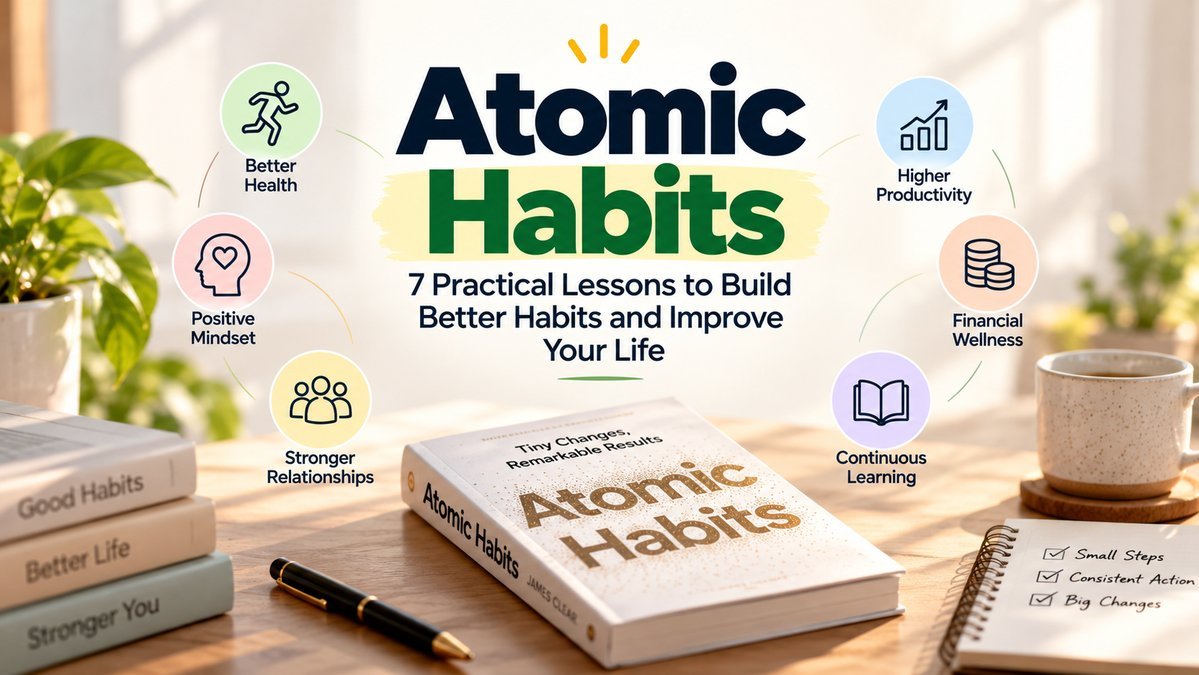
Quick Answer: What Can You Learn From Atomic Habits?
Atomic Habits by James Clear teaches that small behavioural changes, repeated consistently, can contribute to meaningful long-term progress. Its key ideas include identity-based habits, the Four Laws of Behaviour Change, habit stacking, environmental design and tracking your progress.
The practical takeaway is simple: choose one behaviour that matters to you, make it easy to begin and build a routine that fits your real life. Rather than waiting for motivation or expecting immediate results, focus on making the desired behaviour repeatable.
Key Takeaways From Atomic Habits
Start small: A manageable action can make it easier to begin and practise a behaviour consistently.
Build an identity: Connect your habits with the kind of person you want to become.
Design your environment: Make useful behaviours visible and convenient while reducing unnecessary distractions.
Use the Four Laws of Behaviour Change: Make habits obvious, attractive, easy and satisfying.
Connect habits to existing routines: Habit stacking can help you remember new behaviours.
Track progress without demanding perfection: A missed day is an opportunity to adjust, not a reason to abandon your goal.
Think holistically: Apply habit-building principles to health, learning, relationships, daily routines and financial awareness.
What Is Atomic Habits About?
Atomic Habits: An Easy & Proven Way to Build Good Habits & Break Bad Ones is a personal development book written by James Clear. It explains how habits influence everyday behaviour and explores practical ways to make positive routines easier to establish and maintain.
The word “atomic” suggests something very small but potentially powerful. The book applies this idea to daily actions: an individual behaviour may appear insignificant, but repeated actions can influence the direction of your life over time.
For example, reading two pages every day might not seem like a major achievement. However, when reading becomes part of your regular routine, you create an opportunity to learn consistently. Similarly, a short walk, a regular spending review or a few minutes of focused learning can become part of a broader lifestyle.
The objective is not to expect every small action to produce dramatic results. Instead, it is to develop behaviours that you can continue practising, even when motivation fluctuates.
This approach shifts attention from simply setting goals to building systems that support the actions required to work towards those goals.
1. Focus on Small Improvements Instead of Dramatic Changes
One of the most useful lessons from Atomic Habits is that you do not need to make a massive change to begin improving your life.
Many people start with ambitious plans. They decide to exercise for an hour every day, read one book every week, completely change their diet or wake up much earlier than usual. These plans may feel exciting initially, but they can become difficult to sustain alongside work, family responsibilities and everyday stress.
A smaller starting point can reduce the effort required to begin. It also gives you an opportunity to practise the behaviour without reorganising your entire day.
How to Apply This Lesson in Everyday Life
| Your Goal | A Difficult Starting Point | A More Manageable Start |
|---|---|---|
| Improve fitness | Exercise intensely for one hour every day | Begin with a short, suitable walk |
| Read more books | Finish 30 pages every day | Read two pages before bed |
| Improve nutrition | Change every meal immediately | Plan one more balanced meal |
| Learn a skill | Study for two hours every evening | Practise for 10 minutes |
| Manage money | Redesign your entire financial life in one day | Record your daily spending |
| Reduce phone use | Stop using your phone completely | Keep it away during one focused task |
The smaller version is not necessarily your final destination. It is a starting point that makes the behaviour easier to practise. As the routine becomes more familiar, you can gradually adjust its duration or intensity.
For example, if you want to develop a reading habit, begin with two pages rather than forcing yourself to complete an entire chapter. Once reading becomes a regular part of your evening, you can increase the amount when it suits you.
Holistic Health takeaway: You do not need a perfect day to make progress. Start with one healthy action that fits into the day you already have.
2. Build Habits Around the Person You Want to Become
Another important lesson from Atomic Habits is the connection between habits and identity.
There is a difference between saying, “I want to exercise more,” and thinking, “I am becoming someone who takes care of their health.” The first statement focuses on a desired outcome. The second connects your behaviour with the kind of person you want to become.
This does not mean you must already be fit to consider yourself a healthy person. Instead, each small action can become evidence that you are practising a behaviour that reflects your values.
When you go for a walk even though you feel slightly unmotivated, you practise consistency. When you save money instead of making an unnecessary purchase, you practise financial discipline. When you listen carefully instead of interrupting someone, you practise thoughtful communication.
These actions may appear small, but they give you opportunities to practise the identity you want to develop.
Try an Identity-Based Habit
Complete this sentence:
“I want to become someone who __________.”
Then choose one small behaviour that supports that identity.
| Desired Identity | Small Supporting Behaviour |
|---|---|
| Someone who values health | Make time for suitable physical activity |
| Someone who keeps learning | Read a few pages regularly |
| Someone who manages money thoughtfully | Review spending each evening |
| Someone who communicates well | Listen without interrupting |
| Someone who protects mental well-being | Take a short pause during a stressful day |
| Someone who values relationships | Give loved ones your full attention during conversations |
You do not need to prove your identity through dramatic actions. Focus on practising the behaviours that align with it, and allow your routine to develop gradually.
3. Make Good Habits Obvious, Attractive, Easy and Satisfying
A central framework in Atomic Habits is the Four Laws of Behaviour Change. These principles provide a practical way to understand how you can encourage desired behaviours and make unwanted behaviours less convenient.
The four laws are:
Make it obvious.
Make it attractive.
Make it easy.
Make it satisfying.
Together, they can help you design routines that require less daily decision-making.
Make It Obvious
A habit is easier to remember when its cue is visible and connected to an existing routine.
If you want to read regularly, place your book beside your bed or on your work desk. If you want to walk in the morning, prepare your clothes and shoes the previous evening. The aim is to make the intended behaviour easier to notice.
Make It Attractive
Connect the habit with something you enjoy or value.
For example, listen to an educational podcast while walking, create a comfortable corner for reading or choose a form of movement that you genuinely enjoy. You are more likely to return to a behaviour when the experience feels appealing and appropriate for you.
Make It Easy
Reduce the effort required to begin.
Keep your book accessible, prepare your workout clothes in advance or decide your next day’s priorities before going to sleep. A simple setup can remove unnecessary barriers and make it easier to take the first step.
Make It Satisfying
Give yourself a way to notice progress.
You could mark completed reading sessions on a calendar, maintain a walking log or review your spending at the end of the week. A visible record helps you recognize the effort you are making.
Example: Building a Reading Habit
| Law | Practical Application |
|---|---|
| Obvious | Keep the book on your desk or bedside table |
| Attractive | Choose a topic you genuinely enjoy |
| Easy | Start with two pages |
| Satisfying | Mark each completed reading session |
You can apply the same framework to meal planning, sleep routines, physical activity, focused work and other behaviours that support a balanced lifestyle.
4. Design Your Environment to Support Your Habits
Willpower matters, but your environment also influences everyday decisions.
Consider how often you reach for your phone simply because it is beside you. Compare that with how easy it becomes to read when a book is placed within reach. The difference may not be your motivation; it may be what is most visible and convenient.
Instead of repeatedly fighting unwanted distractions, redesign your surroundings to make the behaviours you value easier to practise.
Small Environmental Changes That Can Help
| Desired Behaviour | Environmental Adjustment |
|---|---|
| Read more often | Keep a book where you usually relax |
| Reduce phone distractions | Place your phone away from your work area |
| Exercise consistently | Prepare suitable clothes and shoes in advance |
| Eat more thoughtfully | Make suitable food options easier to access |
| Maintain a regular sleep routine | Create a calmer bedroom and reduce late-night distractions |
| Save money | Turn off unnecessary shopping notifications and review purchases before buying |
For working professionals, environmental design can be particularly useful. A busy workday already requires many decisions, so reducing small sources of friction may make healthy routines easier to maintain.
You do not need to redesign your entire home or workspace. Begin with one adjustment that supports the behaviour you want to develop.
5. Use Habit Stacking to Build a Routine
Habit stacking is a technique described in Atomic Habits. It involves connecting a new habit to an existing one.
Instead of relying entirely on memory or choosing a completely new time for every activity, you use something you already do as a reminder for the behaviour you want to introduce.
For example, if you make tea every morning, that existing routine can become a reminder to read a few pages. If you usually prepare for bed at a particular time, you can connect that moment with putting your phone away.
Examples of Habit Stacking
After brushing my teeth, I will take a moment to plan my day.
After making my morning tea, I will read two pages.
After lunch, I will take a short walk if my schedule and health allow.
After finishing work, I will spend five minutes reviewing my priorities.
After preparing for bed, I will put my phone away and read a few pages.
After reviewing my monthly expenses, I will identify one spending pattern to improve.
The structure is straightforward:
After I [existing habit], I will [new habit].
Choose an existing routine that happens reliably. Keep the new action small enough to fit naturally into that moment.
For example, someone who struggles to find time for reading may not need an entirely new schedule. Connecting reading with an existing evening routine could make the behaviour easier to remember.
The key is to choose a connection that fits your circumstances rather than copying another person’s routine.
6. Track Your Habits Without Becoming Obsessed With Perfection
Habit tracking can help you understand whether you are practising the behaviour you intended to develop.
A simple calendar, notebook or habit-tracking app can make your efforts visible. It may also help you identify patterns, such as missing a walk on particularly busy workdays or forgetting to read when you use your phone late at night.
However, tracking should support your routine, not become another source of pressure. A missed day does not erase all your previous effort, and an imperfect week does not mean that your approach cannot work.
Use your records to learn what makes the behaviour easier or more difficult.
A Simple Weekly Habit Tracker
| Habit | Mon | Tue | Wed | Thu | Fri | Sat | Sun |
|---|---|---|---|---|---|---|---|
| Read for a few minutes | □ | □ | □ | □ | □ | □ | □ |
| Move my body appropriately | □ | □ | □ | □ | □ | □ | □ |
| Take a mindful pause | □ | □ | □ | □ | □ | □ | □ |
| Review my spending | □ | □ | □ | □ | □ | □ | □ |
| Prepare for tomorrow | □ | □ | □ | □ | □ | □ | □ |
Choose only one or two habits when you are starting. You can add more once the initial behaviours become manageable.
At the end of the week, review what happened. If you repeatedly missed a habit, consider whether its timing, duration or environment needs to change.
The purpose is to notice your actions and learn from them, not to create a perfect streak.
7. Learn to Return to Your Routine After a Setback
Consistency does not mean that you will never miss a workout, skip reading or have a day when your routine falls apart.
Work deadlines, family responsibilities, travel, illness and unexpected events can interrupt even well-established habits. A sustainable system needs to accommodate the reality that not every day will go according to plan.
Suppose you planned to walk every morning but missed several days during a particularly busy week. Instead of deciding that you have failed, identify the obstacle. Perhaps your planned time is unrealistic, or you need a shorter version of the habit for demanding days.
You might begin again with a brief walk or move the activity to a more suitable time.
The important lesson is to treat a setback as information rather than proof that you cannot change.
Create Three Versions of Your Habit
| Version | Example: Daily Movement |
|---|---|
| Minimum | Move for a few minutes when appropriate |
| Normal | Take a 15–20 minute walk |
| Ideal | Complete a longer walk or planned workout |
These are illustrative options, not universal exercise prescriptions. Adapt the activity to your health, fitness and schedule.
Having different versions gives you flexibility. On a busy day, you may choose the minimum version; when you have more time and energy, you may choose the normal or ideal version.
This approach can help you maintain a connection with your routine without demanding the same performance every day.
How to Apply Atomic Habits to Holistic Health
The lessons in Atomic Habits can be applied to more than productivity. They can also support a broader approach to physical, mental, social and financial well-being.
| Area of Well-Being | Small Habit to Practise | How It May Help |
|---|---|---|
| Physical health | Schedule suitable movement | Makes activity part of everyday life |
| Nutrition | Plan one balanced meal in advance | Reduces last-minute decisions |
| Mental well-being | Pause briefly before responding to stress | Creates space for a more thoughtful response |
| Social relationships | Give someone your full attention during a conversation | Encourages intentional communication |
| Financial wellness | Record spending or review purchases regularly | Improves awareness of financial behaviour |
| Personal growth | Read or practise a skill for a few minutes | Creates a repeatable learning routine |
| Sleep and recovery | Follow a consistent wind-down routine | Supports a more regular sleep schedule |
These examples show how one habit-building approach can be adapted to different areas of life. You do not need to improve every area simultaneously. Choose the one that matters most to you right now.
Remember that habits are tools, not guarantees. A small action may support a broader goal, but it does not replace professional healthcare, individualized financial advice or other support when needed.
A Practical 7-Day Atomic Habits Challenge
You do not need to implement every lesson from the book at once. Use the next seven days to practise one small behaviour and observe what helps you stay consistent.
| Day | Action | Example |
|---|---|---|
| Day 1 | Choose one meaningful goal | Improve your reading routine |
| Day 2 | Make the habit obvious | Keep the book on your desk |
| Day 3 | Reduce the effort | Start with two pages |
| Day 4 | Connect it to an existing routine | Read after your evening tea |
| Day 5 | Make progress visible | Mark the completed session |
| Day 6 | Identify an obstacle | Notice what distracted you |
| Day 7 | Review and adjust | Choose a realistic plan for next week |
At the end of the week, ask yourself three questions:
What made the habit easier to practise?
What regularly got in the way?
What is one adjustment I can make next week?
You can repeat this process with another habit once you have developed a manageable routine. Your aim is not to prove that you can follow a perfect seven-day plan; it is to learn how to build behaviours that fit your life.
Common Mistakes to Avoid When Applying Atomic Habits
Trying to Change Too Many Habits at Once
When you attempt to improve your sleep, diet, fitness, reading and finances simultaneously, you may create an overwhelming routine. Start with one or two priorities and build gradually.
Expecting Immediate Results
Some habits may produce noticeable changes quickly, while others take longer to become established. Avoid judging a useful behaviour solely by what changes in the first few days. Focus on the quality and consistency of your actions.
Depending Entirely on Motivation
Motivation can fluctuate. A clear cue, a manageable starting point and a supportive environment can make it easier to act when enthusiasm is low.
Copying Someone Else’s Routine
A routine that works for another person may not suit your job, family responsibilities, health or preferences. Adapt the principles to your circumstances instead of treating someone else’s schedule as a universal formula.
Treating a Missed Day as Failure
One interruption does not mean that a habit is permanently broken. Review the reason, adjust your approach and resume when appropriate.
Confusing Small Habits With Guaranteed Success
Small actions can support progress, but outcomes also depend on circumstances, resources, health and other factors. Habits are useful tools, not promises of specific results.
Frequently Asked Questions About Atomic Habits
What is the main message of Atomic Habits?
The main message is that small, repeated behavioural changes can contribute to meaningful long-term progress. The book encourages readers to focus on systems, identity and the environment that supports their habits rather than relying only on goals or motivation.
Who wrote Atomic Habits?
Atomic Habits: An Easy & Proven Way to Build Good Habits & Break Bad Ones was written by James Clear, an author who focuses on habits, behaviour and continuous improvement.
What are the Four Laws of Behaviour Change?
The four laws are to make a habit obvious, attractive, easy and satisfying. They provide a practical framework for encouraging desired behaviours and making unwanted behaviours less convenient.
How can beginners apply Atomic Habits?
Choose one behaviour that matters to you, make it small, connect it to an existing routine and create a clear reminder. Track your progress simply and adjust your approach when obstacles appear.
How long does it take to build a habit?
There is no single timeline that applies to every habit or person. The time needed depends on the behaviour, the context, individual circumstances and how consistently the habit is practised. Focus on making the behaviour repeatable rather than expecting it to become automatic by a particular date.
Can Atomic Habits help with health and fitness?
Its habit-building principles can help you organize behaviours related to movement, meal planning, sleep and other lifestyle routines. They do not replace individualized healthcare guidance or guarantee specific health outcomes.
Is Atomic Habits worth reading?
It may be useful for readers who want a practical framework for understanding habits, adjusting their environment and making routines easier to repeat. As with any personal development book, the value comes from thoughtfully applying relevant ideas to your own circumstances.
What is habit stacking?
Habit stacking involves connecting a new behaviour to an existing routine. For example, you might read a few pages after making your morning tea. The existing activity acts as a reminder for the new habit.
How can I stay consistent when I have a busy job?
Choose a small behaviour, connect it to an existing routine and reduce the effort required to begin. Prepare in advance when possible, allow flexibility on demanding days and review obstacles instead of abandoning the routine after a setback.
Final Takeaway: Small Habits Can Support a More Balanced Life
You do not need to change your entire life in one day. You can begin by reading two pages, taking a short walk, planning tomorrow’s priorities or reviewing one spending decision.
The lesson from Atomic Habits is not that every small action guarantees a dramatic result. It is that repeatable behaviours can help you build a more intentional way of living.
At Holistic Health with Pravin, we believe personal growth should support your whole life—not just your productivity. The habits you develop should help you care for your body, manage your thoughts, strengthen your relationships and make more thoughtful financial decisions.
Choose one small habit today. Make it easy to begin, give it a place in your routine and learn from the process as you go. You do not have to become a completely different person overnight. You can start by practising one behaviour that reflects the person you want to become.
Explore More Book Insights
Books can offer useful ideas, but their real value comes from how thoughtfully we apply those ideas in everyday life. Explore the Book Insights category on Holistic Health with Pravin for practical lessons from personal development books, habit-building guides and other resources that can support a more balanced lifestyle.
This article is an original, practical discussion of ideas inspired by Atomic Habits. It is not a reproduction of the book and is not affiliated with or endorsed by the author or publisher.