
Leadership Lessons from the Bhagavad Gita
Quick Answer
The Bhagavad Gita offers timeless leadership wisdom through the story of Arjuna’s crisis on the battlefield — teaching that true leadership means acting from duty rather than ego, making sound decisions under pressure, staying emotionally steady through uncertainty, and focusing on right action instead of obsessing over outcomes.
A 5,000-Year-Old Leadership Manual You Didn’t Know You Needed
Most leadership advice today comes wrapped in frameworks, acronyms, and quarterly KPIs. Useful, but often thin when you’re the one standing in the room, facing a decision nobody else wants to make, with consequences riding on your judgment.
Long before management consultants existed, one of the world’s most profound texts was already wrestling with exactly that problem.
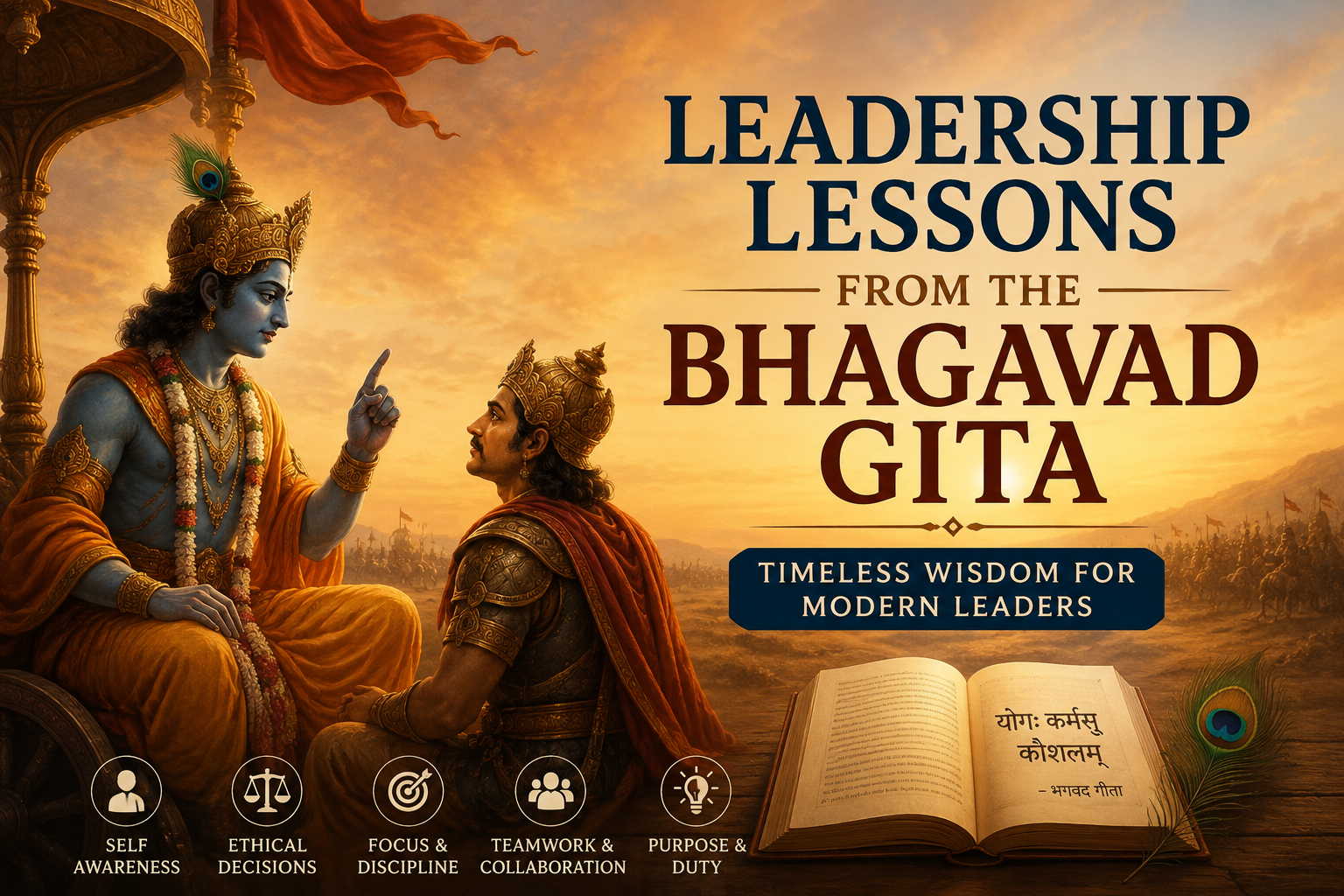
The Bhagavad Gita opens with a warrior named Arjuna standing on a battlefield, paralyzed. Facing a war he doesn’t want to fight, against people he loves and respects, he freezes — overwhelmed by doubt, grief, and the weight of a decision only he can make. What follows is a conversation with Krishna, his guide and charioteer, that unpacks duty, action, self-mastery, and clarity of mind under extreme pressure.
Strip away the battlefield setting, and Arjuna’s dilemma looks remarkably familiar to anyone who has ever led a team, run a business, or had to make a call that would disappoint someone no matter what they chose.
This isn’t a religious lecture — it’s a leadership case study preserved for thousands of years. Here’s what it still has to teach us.
In this guide, you’ll learn:
- Why Arjuna’s crisis is one of the earliest recorded studies in decision-making under pressure
- What “leading through duty, not ego” actually looks like in practice
- How to stay emotionally steady when a decision has real consequences
- Why detaching from outcomes can make you a more effective leader, not a less driven one
- Practical ways to apply these principles at work today
The Setting: A Leader Frozen by Doubt
Before the philosophy, it helps to understand the moment that triggers it.
Arjuna is a skilled, respected warrior standing at the front of an army, about to go into a war that has been building for years. But as he looks across the battlefield, he sees teachers, relatives, and old friends on the opposing side. Suddenly, the abstract idea of duty collides with the very real cost of the decision in front of him.
He doesn’t lack courage or capability. He lacks clarity. And that’s precisely the state so many leaders find themselves in during high-stakes moments — not because they’re unqualified, but because the emotional weight of the decision clouds their judgment.
Krishna doesn’t hand Arjuna a simple answer. Instead, he walks him through a way of thinking that allows him to act with clarity, conviction, and a steady mind — regardless of how uncomfortable the situation is.
Lesson 1: Lead From Duty, Not Ego
One of the Gita’s central ideas is dharma — roughly translated as one’s duty or rightful responsibility in a given role. Krishna’s guidance to Arjuna isn’t about personal glory or self-interest; it’s about fulfilling the responsibility his position demands.
For a modern leader, this translates into a simple but demanding standard: make decisions based on what your role and your people actually need, not what protects your ego, your image, or your comfort.
Ego-driven leadership tends to prioritize being right, being liked, or avoiding blame. Duty-driven leadership prioritizes the outcome that genuinely serves the team or organization, even when that means an unpopular call, an uncomfortable conversation, or admitting a mistake.
Lesson 2: Decision-Making Under Pressure Requires a Steady Mind
Arjuna’s paralysis wasn’t a failure of intelligence — it was a failure of composure. Overwhelmed by emotion, he couldn’t think clearly enough to act at all.
Krishna’s response focuses heavily on equanimity — a mind that stays balanced regardless of external circumstances. Not detachment from caring, but freedom from being controlled by fear, anxiety, or panic in the moment a decision needs to be made.
For leaders, this shows up constantly: a product launch goes wrong, a key employee resigns without warning, a client threatens to walk. The leaders who navigate these moments well aren’t the ones who feel no pressure — they’re the ones who’ve trained themselves not to let pressure hijack their judgment.
Practically, this looks like:
- Pausing before reacting, even briefly, in high-stakes moments
- Separating the facts of a situation from the emotional story around it
- Making the decision the situation calls for, not the decision that relieves immediate discomfort
Lesson 3: Focus on Right Action, Not Just the Outcome
Perhaps the most quoted idea from the Gita is the principle of nishkama karma — action performed with full effort and sincerity, without obsessive attachment to the result.
This can sound counterintuitive for leaders trained to be relentlessly outcome-focused. But there’s a subtle and important distinction here: it isn’t about not caring how things turn out. It’s about not letting anxiety over the outcome compromise the quality of the effort itself.
A leader consumed by fear of failure often makes worse decisions — playing it safe, micromanaging, or avoiding necessary risks. A leader who commits fully to doing the right thing well, while accepting that outcomes are never entirely within their control, tends to make clearer, more courageous decisions.
In practice, this means setting a high standard for the effort and judgment you bring to a decision, and then releasing the compulsive need to control everything that happens afterward.
Lesson 4: True Guidance Is Not Command — It’s Clarity
Krishna never simply orders Arjuna what to do. Instead, he helps Arjuna see the situation more clearly, understand his own values, and arrive at a decision he can stand behind.
This is a strikingly modern definition of leadership: the best leaders don’t just issue directives — they help the people around them think more clearly. A manager who only tells people what to do creates dependence. A leader who helps their team reason through a problem builds capability that outlasts any single decision.
This applies just as much to how leaders guide themselves. Journaling, mentorship, honest self-reflection, or simply talking a decision through with someone you trust often serves the same function Krishna serves for Arjuna — creating enough clarity to act with conviction.
Lesson 5: Self-Mastery Comes Before Leading Others
Much of the Gita’s guidance centers on mastering one’s own mind — discipline, self-awareness, and the ability to observe one’s own reactions rather than being ruled by them.
This is a principle that modern leadership research keeps circling back to as well: leaders who understand and regulate their own emotional reactions tend to build calmer, more trusting teams. The reverse is also true — a leader who is reactive, anxious, or unpredictable tends to create the same instability in the people around them.
Self-mastery isn’t about suppressing emotion. It’s about developing enough awareness that emotion informs your decisions without controlling them.
Bringing These Lessons Into Everyday Leadership
- Before a big decision, pause and ask: Am I responding to what this situation actually needs, or to what protects my ego?
- When pressure spikes, slow down deliberately. A short pause before reacting almost always produces a better decision than an immediate reaction.
- Commit fully to the effort, release the grip on the outcome. Do the work at the highest standard you can, and accept that some variables will always be outside your control.
- Help your team think, don’t just hand them answers. Ask questions that build their judgment, not just their compliance.
- Build self-awareness deliberately. Reflection, mentorship, and honest feedback all strengthen the self-mastery that steady leadership depends on.
Common Misconceptions
Myth: The Gita’s teachings are about passivity or detachment from work.
The philosophy actually calls for full, committed action — it simply separates the quality of effort from anxious attachment to results.
Myth: These lessons are only relevant in a religious or spiritual context.
The core ideas — composure under pressure, duty over ego, guiding rather than commanding — are secular leadership principles that show up in modern psychology and management research as well.
Myth: Equanimity means not caring about outcomes.
It means not being destabilized by outcomes — a leader can care deeply about results while still maintaining a steady, clear mind through the process.
Frequently Asked Questions
What is the main leadership lesson in the Bhagavad Gita?
That true leadership comes from fulfilling one’s duty with a clear, steady mind — acting decisively and sincerely, while releasing the anxious need to control every outcome.
How does the Bhagavad Gita apply to modern business leadership?
Its principles map directly onto challenges like decision-making under pressure, staying composed during crises, leading without ego, and mentoring others toward independent judgment rather than dependence.
What is nishkama karma, and why does it matter for leaders?
It refers to performing action with full sincerity and effort, without being anxiously attached to the result. For leaders, this supports clearer decision-making and reduces fear-driven, overly cautious choices.
Do I need to be religious to apply these leadership lessons?
No. These lessons are widely studied as philosophical and psychological principles, independent of religious belief, and are applicable to anyone in a position of responsibility.
How can I start applying these principles at work?
Start with composure: build a habit of pausing before reacting under pressure. From there, practice separating your effort from your attachment to outcomes, and focus on helping your team build their own clarity rather than simply issuing instructions.
Key Takeaways
- Lead from duty and responsibility, not ego or self-image.
- A steady, composed mind is what allows good decisions under real pressure.
- Commit fully to the effort of a decision; release the anxious grip on its outcome.
- The best leadership creates clarity in others, rather than just issuing commands.
- Self-mastery — understanding and regulating your own reactions — is the foundation everything else is built on.
Final Thoughts
Arjuna’s crisis on the battlefield wasn’t really about the war. It was about a leader facing a decision that mattered, in a moment loud with fear, grief, and doubt — and having to find enough clarity to act anyway.
That’s a scenario every leader eventually faces, whether the stakes are a battlefield or a boardroom. The Bhagavad Gita’s enduring relevance isn’t about ancient warfare — it’s about what it takes to stay clear, grounded, and true to your responsibility when it would be far easier to freeze or react from fear.
At Holistic Health with Pravin, leadership is treated as one of the pillars of a well-lived life — not separate from personal growth, but deeply tied to it. Conscious leadership starts with a conscious mind, and that’s a practice worth returning to, in the boardroom and beyond.