
Why Do You Feel Tired by 3 PM? Try This Daily Energy Checklist
Quick Answer
Feeling tired around 3 PM is common because your body’s natural alertness can dip during the afternoon. But if you feel completely drained, sleepy, unfocused or dependent on coffee and sugar every afternoon, your daily habits may be making that normal dip much worse. The good news? You don’t necessarily need another energy drink or a complicated routine. Start by checking seven basics: sleep, hydration, nutrition, movement, daylight, breaks and stress.
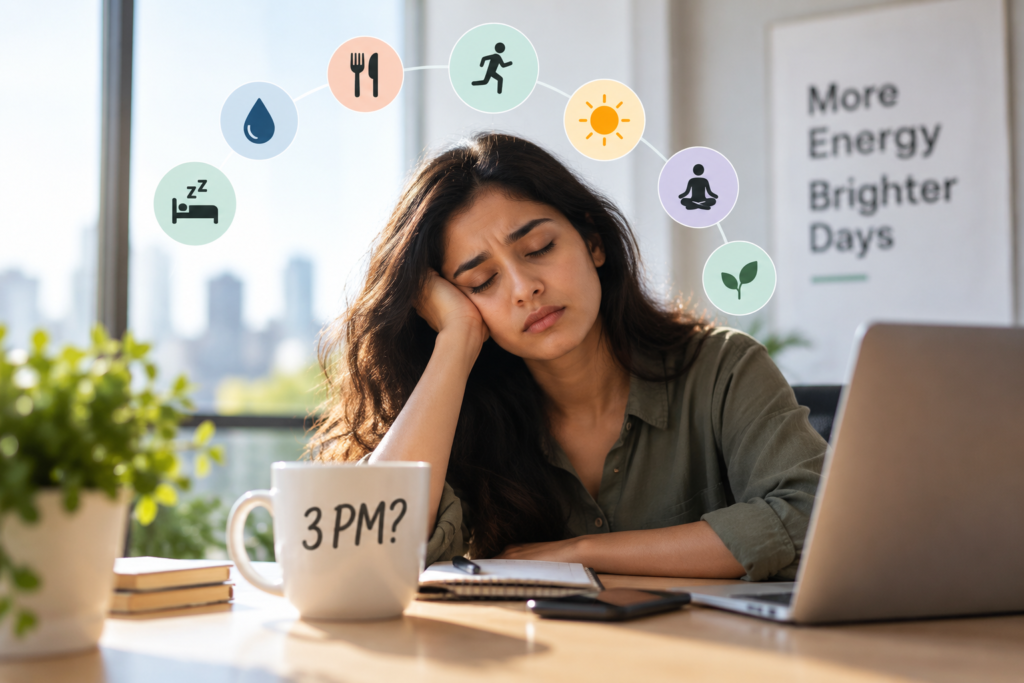
Key Takeaways
A small afternoon dip in energy can be a normal part of your body’s daily rhythm.
Poor sleep, dehydration, heavy meals, inactivity and mental overload can make the dip feel much stronger.
Your 3 PM energy is often influenced by what you did during the previous 8–10 hours.
A simple daily energy checklist can help you identify which habits are draining your energy.
You don’t need to change everything at once. Start with one or two habits and build consistency.
Persistent or unexplained fatigue should be discussed with a qualified healthcare professional.
Detailed Explanation
Why Do You Feel Tired by 3 PM?
Let’s be honest.
Most people don’t wake up thinking:
“Today I’m going to run out of energy by 3 PM.”
Yet it happens.
Morning starts well.
You wake up, get ready, have breakfast, start working and feel productive.
Then lunch happens.
A couple of hours later…
You look at the clock.
3:00 PM.
Suddenly your eyes feel heavy.
Your concentration disappears.
You don’t feel like replying to another email.
That simple task you’ve been working on for 20 minutes still isn’t finished.
And your brain starts saying:
“I need coffee.”
Sound familiar?
You’re not imagining it.
Our alertness naturally changes throughout the day. The afternoon is one period when fatigue and sleepiness can increase because of our circadian rhythm and the buildup of sleep pressure.
But here’s the important part:
A normal afternoon dip and a serious energy crash are not the same thing.
If you’re slightly less energetic but can continue your day, that’s one thing.
If you’re struggling to keep your eyes open, can’t concentrate and need caffeine or sugar just to function, it’s worth looking at your daily habits.
And that’s exactly what the Daily Energy Checklist is designed to do.
The Daily Energy Checklist
Instead of asking:
“What can I take at 3 PM to get my energy back?”
Ask:
“What did I do between waking up and 3 PM?”
Your energy isn’t created at 3 PM.
It’s built throughout the day.
Let’s look at the seven areas that deserve your attention.
1. Sleep: Did You Actually Sleep Enough?
This is the obvious one, but it’s also the one people ignore the most.
If you went to bed at 1 AM and woke up at 6 AM, your morning coffee might make you feel functional.
But it doesn’t magically erase the sleep you missed.
Most adults need at least 7 hours of sleep each night, although individual needs can vary.
When you consistently sleep too little, your afternoon can become the point where your body finally says:
“Enough.”
Ask yourself:
Did I get at least 7 hours of sleep?
Did I wake up feeling reasonably refreshed?
Was my sleep interrupted?
Do I sleep and wake up around the same time most days?
Am I depending on caffeine to compensate for poor sleep?
If you answered “no” to several of these questions, start there.
Simple action
Don’t try to build a perfect nighttime routine overnight.
Start by giving yourself enough time to sleep.
A consistent sleep and wake schedule is a simple place to begin.
2. Hydration: Have You Been Drinking Enough Water?
Here’s something surprisingly easy to forget when you’re busy.
Water.
You can spend hours working, attending meetings, travelling or scrolling through your phone without realizing that you’ve barely had anything to drink.
Dehydration can contribute to symptoms such as tiredness, thirst, dizziness and headache.
Ask yourself:
“How much water have I actually had today?”
Not what you planned to drink.
What you actually drank.
Simple action
Keep water within reach.
Don’t make hydration something you remember only when you’re already exhausted or extremely thirsty.
Your goal isn’t to obsess over a perfect number.
It’s simply to make regular hydration part of your day.
3. Nutrition: What Did You Eat for Lunch?
This is where many afternoon crashes begin.
Think about a typical busy day.
You skip breakfast.
By lunchtime you’re extremely hungry.
You eat quickly.
The meal is large and heavy.
Then you return to your desk.
An hour or two later…
Sleep mode.
Now, food affects everyone differently, so there’s no single “perfect lunch” for everyone.
But generally, a balanced eating pattern with nutrient-dense whole foods can provide a better foundation than relying heavily on highly processed foods and quick sources of sugar.
Ask yourself:
Did I skip meals?
Did I eat extremely quickly?
Was my lunch very heavy?
Did my meal include protein and fiber-rich foods?
Am I reaching for sweets whenever I feel tired?
Don’t think about food only in terms of calories.
Ask:
“Will this meal help me feel good for the next few hours?”
That’s a much more useful question.
4. Movement: Have You Been Sitting Since Morning?
Here’s a simple experiment.
Tomorrow, notice how much you actually move.
You might discover something surprising.
Wake up.
Sit in the car.
Sit at work.
Sit during meetings.
Sit for lunch.
Sit again.
Then sit at home.
Your brain has been working all day.
Your body hasn’t moved much.
Regular physical activity is important for overall health, and WHO recommends adults get 150–300 minutes of moderate-intensity aerobic physical activity per week while reducing sedentary time.
You don’t need to turn your workday into a fitness camp.
Start small.
Simple action
Every few hours:
Stand up.
Walk.
Stretch.
Take the stairs.
Go outside.
A few minutes of movement is better than spending the entire day sitting and waiting for your evening workout to rescue you.
5. Daylight: Have You Seen the Sun Today?
This one is easy to overlook.
You wake up.
Check your phone.
Get ready.
Enter your car.
Reach your office.
Spend the entire day indoors.
Then you return home.
Your body has barely experienced natural daylight.
Light is one of the environmental signals that helps regulate your body’s internal clock. Getting natural light during the day, especially earlier in the day, is part of healthy sleep and circadian habits.
Simple action
Try getting outside in the morning.
Take a short walk.
Sit near natural light.
Have your morning tea or coffee outside when possible.
It doesn’t need to be complicated.
6. Breaks: When Was Your Last Real Break?
There’s another reason your 3 PM energy disappears.
You’ve been mentally “on” for hours.
Email.
WhatsApp.
Meetings.
Calls.
Deadlines.
Notifications.
Social media.
More work.
Your brain never gets a proper pause.
CDC/NIOSH guidance notes that fatigue can increase with prolonged time-on-task, while appropriate breaks can help reduce fatigue.
But there’s an important difference between a break and more stimulation.
Scrolling through 50 reels while sitting at your desk isn’t necessarily the mental reset you need.
Try a real break:
Get up.
Drink water.
Walk outside.
Look away from your screen.
Take a few quiet minutes.
Talk to someone.
Then come back.
Sometimes your brain doesn’t need more entertainment.
It needs less information.
7. Stress: Where Is Your Mental Energy Going?
Not all tiredness is physical.
Sometimes your body is fine.
Your brain is simply overloaded.
Maybe you’re thinking about money.
A deadline.
A difficult conversation.
Family responsibilities.
A business problem.
An unfinished task.
Or ten different things at once.
You may be sitting quietly at your desk while your mind is running in ten directions.
That’s exhausting.
Ask yourself:
“What is taking up most of my mental space right now?”
You may find that your biggest energy drain isn’t lack of sleep.
It’s mental overload.
Simple action
Before starting work, identify your top three priorities.
Not fifteen.
Three.
Finish one important thing before constantly jumping between tasks.
Reducing unnecessary mental switching can make your workday feel much lighter.
Practical Action Plan
You don’t need to completely change your lifestyle tomorrow.
Try this simple routine for the next 7 days.
Morning
☐ Wake up at a reasonably consistent time
☐ Drink water
☐ Get some natural daylight
☐ Move your body
☐ Eat a balanced meal if you normally eat breakfast
☐ Decide your top three priorities
During Work
☐ Keep water nearby
☐ Avoid sitting continuously for several hours
☐ Take short movement breaks
☐ Take genuine mental breaks
☐ Avoid unnecessary multitasking
☐ Get some daylight if possible
Lunch
Before eating, ask:
“What will help me feel good for the next few hours?”
Build your meal around nutritious, minimally processed foods and a balance that works for you.
Eat slowly when possible.
And don’t immediately return to your screen if you have the opportunity to take a short walk afterward.
Your 3 PM Reset
When 3 PM arrives and you feel tired, don’t immediately reach for coffee.
Pause for two minutes.
Ask yourself:
SLEEP
Did I sleep enough?
WATER
Have I been drinking regularly?
FOOD
Was my meal balanced?
MOVEMENT
Have I moved today?
LIGHT
Have I spent any time in natural daylight?
BREAK
Have I actually rested?
STRESS
What is consuming my mental energy?
Then fix the easiest problem first.
Maybe you need water.
Maybe you need movement.
Maybe you’ve been staring at your screen for four hours.
Maybe you simply need a short mental reset.
Don’t always treat the symptom. Look for the habit behind it.
Evening: Build Tomorrow’s Energy Tonight
Your tomorrow doesn’t start tomorrow morning.
It starts tonight.
If you’re constantly sleeping late, waking up exhausted and then trying to compensate with caffeine, your afternoon energy problem may simply keep repeating.
Create a realistic evening routine.
Give yourself enough time for sleep.
Reduce unnecessary stimulation before bed.
Try to maintain a consistent sleep schedule.
And remember:
You don’t have to have a perfect night.
You just need a better pattern.
Common Mistakes
1. Using coffee as a substitute for sleep
Coffee can increase alertness, but it cannot replace adequate sleep.
If you’re consistently sleep-deprived, adding more caffeine isn’t a real solution.
2. Waiting until you’re exhausted to drink water
Make hydration part of your routine instead of an emergency response.
3. Eating only for instant energy
When you’re tired, sweets are tempting.
But think beyond the next 20 minutes.
Ask what will support you for the next several hours.
4. Sitting all day and exercising only once
A workout is valuable.
But movement throughout the day matters too.
5. Calling scrolling “rest”
Sometimes your brain needs a break from information, not another stream of information.
6. Trying to change everything at once
This is probably the biggest mistake.
Don’t wake up tomorrow and try to completely redesign your life.
Pick one habit.
Master it.
Then add another.
FAQs
Why do I feel tired every day at 3 PM?
A natural afternoon dip in alertness can occur because of your circadian rhythm and accumulated sleep pressure. However, insufficient sleep, dehydration, poor nutrition, prolonged sitting, stress and mental fatigue can make afternoon tiredness stronger.
How can I avoid the afternoon energy crash?
Start with the basics: get enough sleep, stay hydrated, eat balanced meals, move regularly, get daylight and take meaningful breaks. Also pay attention to stress and mental workload.
What should I do when I feel tired in the afternoon?
First, pause and check the Daily Energy Checklist: sleep, hydration, nutrition, movement, daylight, breaks and stress. Then address the most obvious gap before automatically reaching for sugar or caffeine.
Is feeling tired at 3 PM normal?
A moderate decrease in alertness during the afternoon can be normal. The CDC’s NIOSH resources identify the afternoon as a period when vulnerability to fatigue can increase.
How much sleep do adults need?
Most adults need at least 7 hours of sleep per night, although individual needs can vary.
Can dehydration make you feel tired?
Yes. Dehydration can be associated with symptoms such as tiredness, thirst, dizziness and headache.
Does exercise help with energy?
Regular physical activity supports overall health and can be an important part of maintaining a healthy daily routine. WHO recommends adults accumulate 150–300 minutes of moderate-intensity aerobic physical activity each week.
What is the Daily Energy Checklist?
The Daily Energy Checklist is a simple self-check covering seven areas that can influence your daily energy: sleep, hydration, nutrition, movement, daylight, breaks and stress.
When Should You Consult a Professional?
Occasional afternoon tiredness is one thing.
But if you’re consistently exhausted, your fatigue is getting worse, or you feel tired even after getting adequate sleep and maintaining healthy habits, don’t simply assume that you need more motivation.
Persistent or unexplained fatigue can have many possible causes.
Consider speaking with a qualified healthcare professional if:
Your fatigue continues for an extended period.
It significantly affects your work or daily activities.
You regularly feel exhausted despite adequate sleep.
You experience other concerning symptoms.
Your energy levels suddenly change without an obvious reason.
You are frequently falling asleep unintentionally during the day.
A checklist can help you identify lifestyle patterns.
It cannot diagnose a medical condition.
Sources
CDC / National Institute for Occupational Safety and Health, information on fatigue, circadian rhythms and afternoon alertness.
CDC, sleep recommendations and healthy sleep habits.
World Health Organization, Guidelines on Physical Activity and Sedentary Behaviour.
NHS, information on dehydration and related symptoms.
About the Author
Pravin Patil
Pravin Patil is the creator of Holistic Health by Pravin, a personal health and lifestyle platform focused on helping people build a more balanced life.
His approach to holistic health looks beyond just physical fitness.
It includes four important areas:
Physical Health. Mental Health. Social Health. Financial Health.
Through practical educational content, the goal is to help people understand everyday habits, make better decisions and build a healthier and more balanced lifestyle.
Health is not about perfection. It’s about progress, consistency and balance.
Ready to Improve Your Daily Energy?
You don’t need to change your entire life today.
Start small.
Tonight, look at your sleep.
Tomorrow, focus on hydration.
Take a short walk.
Get some daylight.
Take a proper break.
Then notice how you feel at 3 PM.
Because better energy isn’t always about finding a quick fix.
Sometimes it’s about giving your body the basics it has been asking for all along.
Want more practical tips for building a healthier, more balanced lifestyle?
Explore more articles from Holistic Health by Pravin and follow along for simple, practical content covering energy, nutrition, mindset, daily habits, wellness and financial health.
Your better 1% starts with one small habit today.