
Digital Detox Protocols for Entrepreneurs: How Unplugging Increases Strategic Clarity
Entrepreneurship rewards speed. You answer the client’s message quickly, check email before breakfast, and respond to a teammate over lunch. Somewhere between the notifications, meetings, and endless tabs, your ability to think clearly gets lost. Entrepreneurs are expected to make decisions constantly, and those decisions require more than information — they require mental space. A digital detox for entrepreneurs doesn’t mean disappearing from the internet for a week. It means creating intentional periods when you stop consuming information and start thinking independently, so technology works for your priorities instead of controlling them.
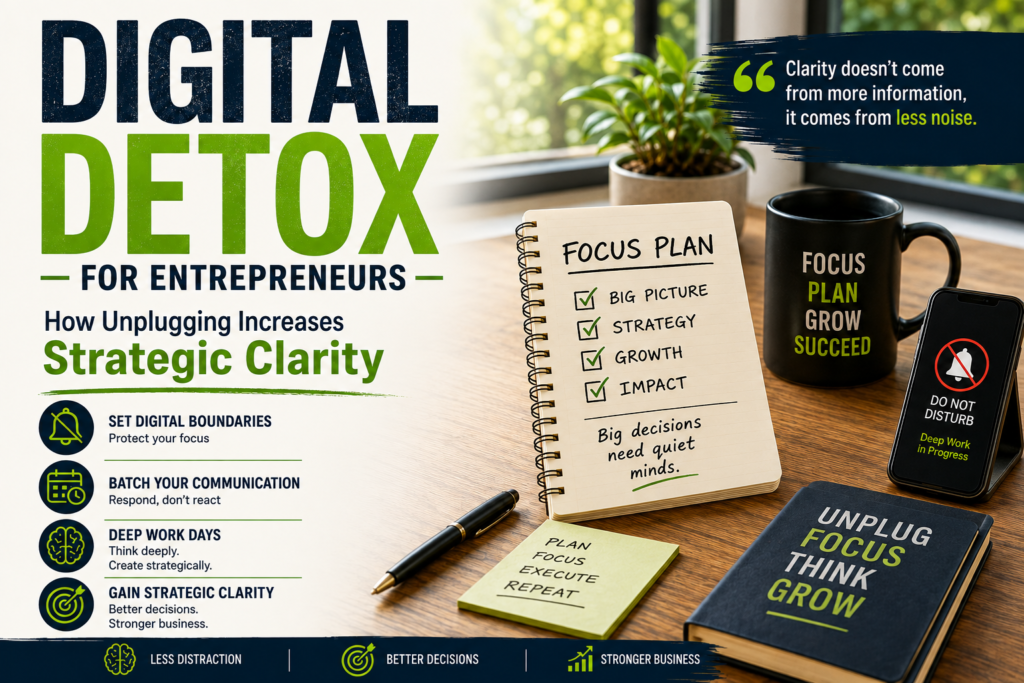
What Is a Digital Detox for Entrepreneurs?
A digital detox for entrepreneurs is a deliberate period or system of reducing non-essential digital activity to restore concentration, reduce distractions, and create space for higher-quality thinking. Unlike a traditional digital detox, entrepreneurs usually can’t completely disconnect, so the approach should be strategic rather than extreme. Instead of asking how to stop using technology, ask which digital activities actually require attention and which are simply consuming it.
1. Essential Digital Work
Activities that directly support the business: customer communication, financial management, business operations, important emails, team communication, sales activities, scheduled meetings, and critical business software. These shouldn’t necessarily disappear.
2. Useful but Non-Essential Activity
Valuable but not always urgent: industry news, LinkedIn, market research, YouTube tutorials, newsletters, analytics checks, and competitor research. These can be batched and scheduled.
3. Digital Noise
Where entrepreneurs lose the most hours: endless social media scrolling, constant notification checking, repeatedly refreshing email, unplanned WhatsApp conversations, random browsing, and app-switching. It doesn’t look unproductive, which is what makes it dangerous.
Why Entrepreneurs Need Digital Detox More Than Ever
Every notification creates a potential interruption, every interruption creates a context switch, and every context switch makes deep concentration harder. An entrepreneur thinking through pricing strategy who gets pulled into WhatsApp, email, task apps, and LinkedIn one after another often loses the original thought entirely. This isn’t just a time-management problem — it’s an attention-management problem.
Digital Distraction Is More Expensive for Decision-Makers
For employees, losing 20 minutes may just mean lost productivity. For entrepreneurs, the cost is higher: rushed hiring decisions, poor pricing calls, unnecessary investments, or reactive marketing and sales decisions instead of strategic ones. Because entrepreneurs make decisions that affect the whole organization, protecting thinking time has an unusually high return.
The Connection Between Digital Detox and Strategic Clarity
Strategic clarity means understanding where the business stands, what matters most, what to do next, and what to ignore. Constant digital stimulation keeps the brain reacting to external input. A digital detox creates a temporary shift from reaction to reflection — instead of responding to whatever appears on screen, you deliberately choose what deserves attention.
The 10 Digital Detox Protocols
Protocol #1: Create Digital Boundaries
Establish clear boundaries so technology doesn’t expand to fill every available space. Start one or two ‘no-notification’ windows each day (e.g., 8:00-10:00 AM) where messaging, email, and social media are closed. Start with 30 minutes if two hours feels unrealistic; consistency matters more than duration.
Protocol #2: Stop Checking Email Continuously
Treat email as asynchronous communication, not instant messaging. Create specific windows (e.g., 9:30-10:00 AM, 2:00-2:30 PM, 5:30-6:00 PM) and keep email closed otherwise. This shifts the mindset from ‘what has arrived?’ to ‘what do I need to accomplish?’
Protocol #3: Batch Your Communication
Collect emails, WhatsApp messages, Slack, calls, and comments and respond during predetermined blocks (e.g., 10:00-10:30 AM, 2:00-2:30 PM, 5:00-5:30 PM) rather than answering as they arrive. Pair this with an emergency channel for genuinely urgent matters.
Protocol #4: Establish an Emergency Communication Rule
Define what ‘urgent’ actually means so you can disconnect without worry — for example, calls are urgent, WhatsApp is important but not urgent, and email is non-urgent. Make sure everyone around you understands the system.
Protocol #5: Schedule an Analog Deep-Work Day
Choose one day or half-day per week to reduce digital activity and stop consuming information. Work with paper, notebooks, whiteboards, printed reports, and books instead of email, social media, and dashboards.
Protocol #6: Use the 'One Problem, One Page' Method
Write one business problem at the top of a blank page (e.g., ‘Why aren’t our sales growing?’) and divide the page into four sections: what we know, what we don’t know, possible causes, and what to test next.
Protocol #7: Create a Morning Digital Firewall
Avoid social media, email, news, and non-urgent messages for the first 30-60 minutes of the day. Instead review priorities, journal, exercise, read, or plan the day. The goal: think before you consume.
Protocol #8: Separate Information Consumption From Decision-Making
Create distinct information blocks (research) and decision blocks (deciding) instead of mixing them, so research doesn’t become a substitute for progress.
Protocol #9: Create a 'Digital Diet'
Treat information consumption like food: keep what helps you make better decisions, reduce what makes you feel busy, limit what makes you anxious or reactive, and question habitual consumption.
Protocol #10: Design a Weekly CEO Thinking Session
Schedule 60-90 minutes weekly with no meetings, email, messaging, or devices. Use a notebook to work through questions on business, customers, money, team, and strategy.
The 3-Level Digital Detox Framework
Daily Detox
30-60 minutes without digital distractions, batched communication, disabled unnecessary notifications, and one protected deep-work block.
Weekly Detox
A 60-90 minute CEO thinking session, reduced social media, strategic review, and analog planning.
Monthly Detox
Several hours, or a full day, away from unnecessary digital activity, used for business strategy, financial review, long-term planning, reading, and reflection.
How to Know If Your Digital Detox Is Working
Don’t measure success by hours spent offline — measure decision quality. Ask whether you’re finishing important work faster, less reactive, more confident in decisions, checking messages less, thinking more creatively, sleeping better, and clearer about priorities.
Common Digital Detox Mistakes Entrepreneurs Make
Trying to Disconnect Completely
A complete digital disappearance isn’t practical for most business owners. Start small and build a system you can maintain.
Keeping Notifications On
Active notifications keep the brain anticipating interruptions. Turn off anything that isn’t genuinely important.
Calling Social Media 'Research'
Sometimes it is research, sometimes it’s entertainment disguised as research — be honest about which.
Checking Messages During Deep Work
Even a quick glance can destroy concentration. Protect deep-work sessions fully.
Creating Rules That Are Too Complicated
Start with three simple rules: no notifications during deep work, check communication at scheduled times, and hold one weekly strategic thinking session.
A Practical 7-Day Digital Detox Challenge for Entrepreneurs
Day 1: Audit Your Digital Habits
Track how often you check email, WhatsApp, social media, news, and dashboards without changing anything yet.
Day 2: Remove Unnecessary Notifications
Turn off notifications that aren’t essential.
Day 3: Create Two Communication Windows
Choose two specific periods for email and messaging.
Day 4: Protect One Deep-Work Block
Work at least 60 minutes without notifications.
Day 5: Avoid Digital Consumption Before Work
Start the day without social media, email, or news.
Day 6: Conduct an Analog Strategy Session
Use paper and pen to think through one major business challenge.
Day 7: Review the Results
Ask what changed, what felt difficult, what created clarity, and which habits should become permanent.
Digital Detox Doesn't Mean Becoming Anti-Technology
Technology remains one of the greatest tools available to entrepreneurs — cloud software, AI, CRM systems, communication tools, and analytics all improve operations. The problem isn’t technology; it’s uncontrolled access to attention. The goal is not less technology, but intentional technology.
Digital Detox vs. Productivity
Productivity asks how much got done; strategic effectiveness asks whether the right things were worked on. An entrepreneur can answer 100 emails and attend eight meetings and still make no meaningful progress, while two uninterrupted hours on a major business problem can create more value than a full day of reactive work. Digital detox can become a strategic advantage, not just a productivity technique.
Frequently Asked Questions About Digital Detox for Entrepreneurs
What is the best digital detox strategy for entrepreneurs?
A structured rather than extreme approach: disable unnecessary notifications, batch communication, protect daily deep-work time, and schedule a weekly technology-light strategy session.
How long should an entrepreneur do a digital detox?
There’s no universal duration. Even 30-60 minutes of uninterrupted, distraction-free work daily can help, with longer weekly or monthly periods introduced gradually.
Does digital detox improve productivity?
It can, by reducing interruptions and protecting focused work, and more importantly by creating space for strategic thinking and better decision-making.
Should entrepreneurs stop using social media?
Not necessarily — it’s often important for marketing, networking, and brand building. The better approach is scheduling social media activity rather than letting it consume attention throughout the day.
How can entrepreneurs disconnect without missing important messages?
Create an emergency communication system, such as designating calls as urgent while treating email and routine messaging as asynchronous, and make sure employees and contacts know the system.
What is an analog deep-work day?
A period dedicated to concentrated thinking and planning with minimal digital stimulation, using notebooks, whiteboards, and printed documents instead of switching between digital platforms.
Can digital detox help with decision-making?
Yes — reducing unnecessary digital input can create more mental space for reflection, helping entrepreneurs evaluate problems carefully instead of constantly reacting to incoming information.
The Entrepreneur's Digital Detox Checklist
- Are unnecessary notifications turned off?
- Do I know my most important task?
- Have I scheduled communication time?
- Do I have a distraction-free deep-work block?
- Am I consuming information intentionally?
- Have I protected time for strategic thinking?
- Do people know how to reach me in an emergency?
- Have I separated research from decision-making?
Key Takeaways
- A digital detox for entrepreneurs should be strategic, not extreme.
- Digital boundaries help protect attention from unnecessary interruptions.
- Communication batching reduces constant context switching.
- Analog deep-work sessions create space for strategic thinking.
- Entrepreneurs should separate information consumption from decision-making.
- A weekly CEO thinking session can improve strategic clarity.
- The goal isn’t to eliminate technology but to use it intentionally.
- Protecting attention can be one of the highest-leverage productivity strategies for business owners.
Final Thoughts: Protect Your Attention Like a Business Asset
Entrepreneurs spend enormous amounts of time protecting their money, employees, intellectual property, and customers, but one of their most valuable assets is often overlooked: attention. A digital detox isn’t about abandoning technology — it’s about reclaiming control over attention. Start with one notification-free hour, batch communication, create a weekly strategy session, and try an analog deep-work period, then observe what changes.
Recommended starting point: Turn off non-essential notifications today and schedule your first 60-minute distraction-free strategy session this week.