
Quick Answer
The most effective healthy habits are usually simple and sustainable: eat a varied diet, move regularly, sleep well, stay hydrated, manage stress, spend time with people you care about, limit prolonged sitting, avoid tobacco, maintain preventive healthcare, and create routines you can actually follow. You don’t need to completely change your lifestyle overnight. Consistent small improvements can build a stronger foundation for long-term health.
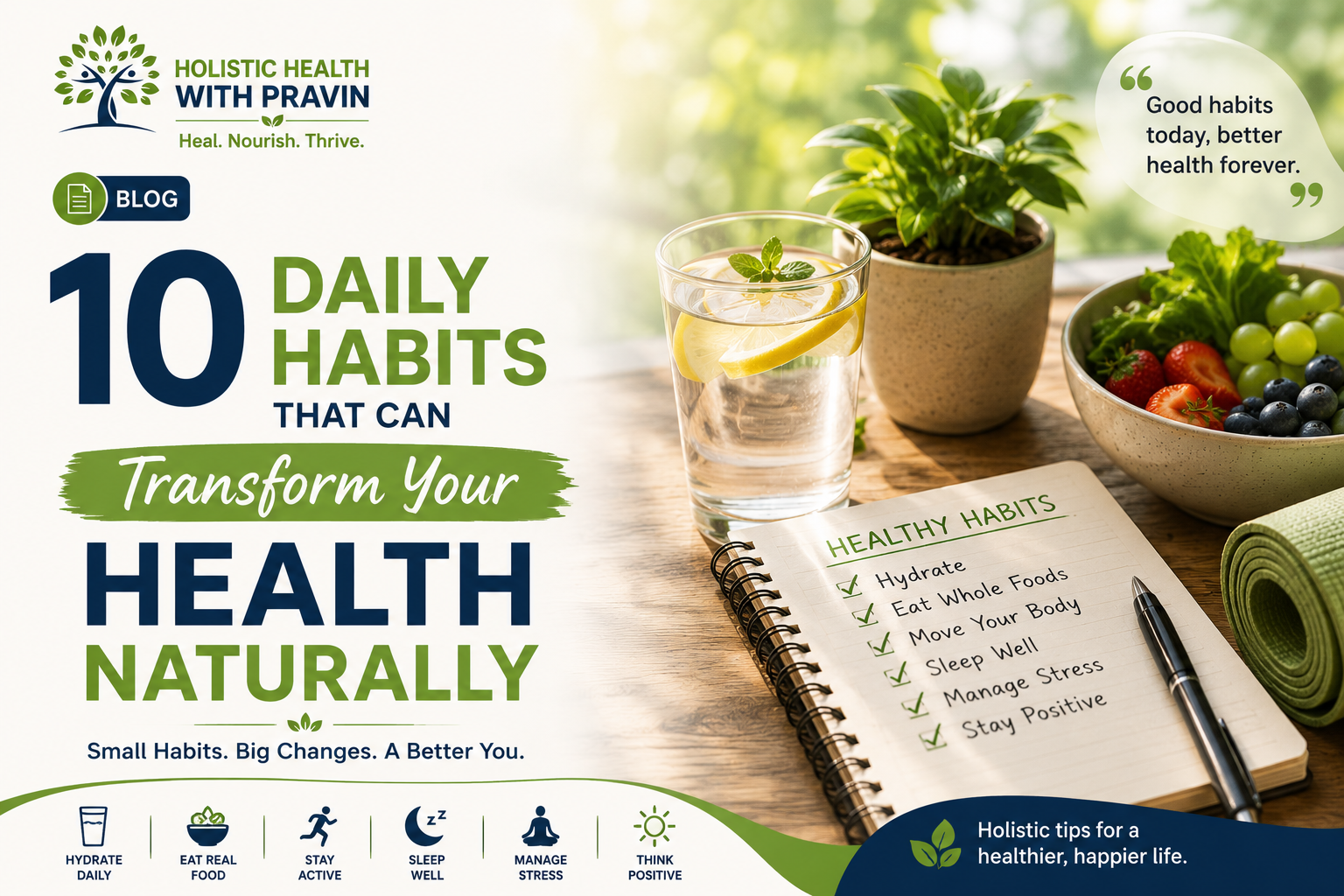
Introduction
You don’t need to wake up at 5 a.m., spend two hours in the gym, meditate for an hour, or completely eliminate your favorite foods to live a healthier life.
Yet that’s often what social media makes healthy living look like.
One person says you need a perfect morning routine. Another recommends an extreme diet. Someone else claims that a particular drink, supplement, workout, or detox routine will completely transform your health.
The result?
People become overwhelmed before they even start.
The reality is much less complicated.
Your health is shaped by what you repeatedly do—not by what you occasionally do perfectly.
The meal you choose most days matters. The amount you move throughout the week matters. Your sleep schedule matters. How you respond to stress matters. Your relationships, environment, and everyday choices matter too.
A healthy lifestyle is therefore less about chasing a perfect routine and more about building small habits that are realistic enough to repeat.
Current guidance from the World Health Organization emphasizes a combination of healthy eating, regular physical activity, and other lifestyle choices as important foundations for health. WHO also notes that healthy diets should be varied and adapted to individual needs, cultural practices, and locally available foods.
So instead of asking:
“What’s the fastest way to become healthy?”
A better question is:
“What can I realistically do every day that will make my health a little better?”
In this article, we’ll explore 10 daily healthy habits that can help you build that foundation—without turning your life into a full-time wellness project.
1. Move Your Body Every Day
Your body was designed to move.
Unfortunately, modern life makes sitting remarkably easy. We sit while working, commuting, watching videos, scrolling through social media, and even ordering food.
The good news is that physical activity doesn’t have to mean spending an hour in the gym.
Walking, cycling, dancing, household work, sports, stretching, and structured exercise all count as physical activity. WHO recommends that adults get 150–300 minutes of moderate-intensity aerobic activity per week, or an equivalent amount of vigorous activity, along with muscle-strengthening activities on at least two days a week.
But don’t get stuck thinking that anything below the target is pointless.
Some movement is better than none.
Try this:
- Take a 10-minute walk after a meal.
- Use stairs when practical.
- Stand up regularly during long work sessions.
- Walk while taking a phone call.
- Do basic strength exercises a few times a week.
- Choose activities you actually enjoy.
The best exercise routine is not necessarily the most impressive one.
It’s the one you can keep doing.
2. Build Your Meals Around Real, Varied Foods
Healthy eating doesn’t require an expensive grocery list.
A good starting point is simply to make your meals more varied.
WHO describes a healthy diet as one built around a variety of foods, including vegetables, fruits, legumes, whole grains or other staple foods, and appropriate sources of protein and fats. It also recommends limiting excessive amounts of free sugars, salt, saturated fats, and industrial trans fats.
For an everyday meal, think about including:
- Vegetables or fruit
- A protein source
- Whole grains or other minimally processed carbohydrate sources
- A source of healthy fat
- Water or another appropriate beverage
You don’t need to make every meal perfect.
Instead, look at your overall eating pattern.
If most of your meals are reasonably balanced, occasional treats can fit into a healthy lifestyle too.
A simple rule:
Add variety before you start removing everything.
3. Make Sleep a Non-Negotiable Habit
People often treat sleep as something they can sacrifice when life gets busy.
Work is important.
Family is important.
Business is important.
But sleep isn’t a luxury left over after everything else is finished. It is a basic part of maintaining health and functioning well.
Poor sleep can affect mood, concentration, energy, and daily performance.
Instead of trying to completely redesign your nighttime routine, start with consistency.
Try this:
- Go to bed and wake up at roughly consistent times.
- Create a relaxing wind-down period.
- Reduce unnecessary screen use before bed.
- Keep your bedroom comfortable and dark.
- Avoid using work as your last activity before sleeping.
And don’t turn sleep into another source of anxiety.
The goal isn’t to create a “perfect” sleep routine.
The goal is to give your body a regular opportunity to rest and recover.
4. Stay Hydrated Throughout the Day
Water is easy to overlook because it doesn’t feel as exciting as food, exercise, or other wellness trends.
But hydration is essential for normal body functions.
Your individual fluid needs can vary depending on factors such as climate, activity level, diet, age, and health status.
Instead of obsessing over a universal number, develop the habit of drinking fluids regularly throughout the day and paying attention to your body’s needs.
Make hydration easier:
- Keep a water bottle nearby.
- Drink water with meals.
- Drink more when you’re physically active or in hot conditions.
- Choose water instead of sugary drinks more often.
And remember: more water isn’t automatically better.
Healthy habits are about meeting your body’s needs—not turning every habit into a competition.
5. Give Your Mind a Daily Reset
Your physical health isn’t the only thing that needs attention.
Your mind also needs recovery.
Modern life gives us a constant stream of notifications, messages, news, work demands, and social media content. Without intentional breaks, your brain can remain in a state of constant stimulation.
A daily mental reset doesn’t have to mean an hour of meditation.
It could be:
- Five minutes of quiet breathing
- Journaling
- Reading
- Walking without your phone
- Spending time outdoors
- Listening to music
- Practicing gratitude
- Simply sitting quietly
The objective is to create moments where you’re not constantly consuming information.
Try asking yourself:
“When was the last time today that I did absolutely nothing for a few minutes?”
That small pause can become surprisingly valuable.
If stress, anxiety, low mood, or other mental health concerns are persistent or interfering with daily life, don’t treat them as merely a lifestyle problem. Speaking with a qualified mental health professional can be an important part of taking care of yourself.
6. Spend Time With People Who Matter
Health is not only about what happens inside your body.
Your social environment matters too.
A meaningful conversation with a friend, a family meal, helping someone, participating in a community, or simply spending quality time with people you care about can contribute to a sense of connection and belonging.
And here’s an important distinction:
Social health isn’t about having hundreds of contacts.
You can have thousands of followers and still feel lonely.
Quality matters.
Make it practical:
- Call someone instead of only texting.
- Eat a meal with family without phones at the table.
- Make time for a friend.
- Join a local group or activity.
- Listen properly when someone is talking.
- Express appreciation more often.
A healthy life should leave room for people, not just productivity.
7. Break Up Long Periods of Sitting
You can exercise regularly and still spend most of your waking day sitting.
That’s why your movement during the day matters too.
If your work involves a desk, don’t wait until your evening workout to move.
Build movement into your workday.
Try:
Every 30–60 minutes:
- Stand up.
- Walk around.
- Stretch.
- Get some water.
- Look away from your screen.
You don’t need a complicated productivity system.
A simple reminder on your phone or computer can help.
WHO notes that physical activity includes movement during work, transportation, household tasks, leisure, and exercise—not just formal workouts.
Think beyond “exercise.”
Think “movement.”
8. Reduce Tobacco Exposure and Be Thoughtful About Alcohol
Some health habits aren’t about adding something.
They’re about removing or reducing things that can harm your health.
Tobacco use is a major preventable health risk. Avoiding tobacco and secondhand smoke is one of the most important choices you can make for long-term health.
Alcohol also deserves an honest conversation. There is no need to pretend that alcohol is a health product. WHO states that alcohol consumption is associated with a wide range of health risks, and that less alcohol means lower risk.
The simplest principle is:
Don’t let “moderation” become an excuse to ignore risk.
If you don’t drink, there is no health reason to start.
If you drink, understanding the risks and reducing consumption can be a meaningful health decision.
9. Don’t Ignore Preventive Healthcare
Healthy habits are important.
But they don’t replace professional healthcare.
One common mistake is believing that if you eat well and exercise, you don’t need checkups.
That’s not how prevention works.
Depending on your age, sex, family history, risk factors, and local healthcare recommendations, preventive care may include:
- Routine health assessments
- Dental checkups
- Eye examinations
- Recommended vaccinations
- Blood pressure monitoring
- Appropriate screening tests
- Following up on persistent symptoms
The exact schedule should be individualized with a qualified healthcare professional.
Remember:
Prevention isn’t about assuming something is wrong.
It’s about not waiting until a problem becomes difficult to ignore.
10. Create a Routine You Can Actually Sustain
This may be the most important habit of all.
You can have the world’s best health plan on paper and still fail if the routine doesn’t fit your real life.
A routine that requires:
- Two hours of exercise
- Perfect meal preparation
- An hour of meditation
- Zero screen time
- Early waking
- Eight hours of uninterrupted sleep
- And complete discipline every day
…might look impressive on Instagram.
It may also be impossible to maintain.
Instead, build a minimum viable healthy routine.
For example:
Morning
- Drink water
- Eat a balanced breakfast if you prefer one
- Get some movement
During the day
- Eat varied meals
- Move regularly
- Take short breaks
- Stay connected
Evening
- Reduce unnecessary stimulation
- Prepare for tomorrow
- Create a consistent sleep routine
The goal isn’t to create a perfect day.
It’s to create a repeatable day.
The Bigger Picture: Don’t Optimize One Habit While Ignoring Everything Else
Here’s where many people get health completely wrong.
They become obsessed with one variable.
Someone spends thousands on fitness equipment but sleeps five hours.
Someone eats an extremely restrictive diet but is constantly stressed.
Someone exercises every day but never takes time to connect with family.
Someone focuses heavily on productivity while ignoring their mental health.
That’s not holistic health.
Your health is a system.
Nutrition supports energy.
Movement supports physical function.
Sleep supports recovery.
Relationships support connection.
Stress management supports mental well-being.
Preventive care helps identify problems early.
The goal is not to maximize one area.
The goal is to build a lifestyle where the important pieces support each other.
Common Mistakes When Building Healthy Habits
Mistake 1: Changing Everything Overnight
Trying to completely transform your lifestyle in one Monday morning is usually a recipe for burnout.
Start with one or two habits.
Build consistency.
Then add another.
Mistake 2: Chasing Trends
A habit being popular on social media doesn’t automatically make it effective or appropriate for everyone.
Look for credible evidence rather than viral claims.
Mistake 3: Expecting Immediate Results
Health is not an overnight project.
Some benefits may be noticeable quickly, while others take much longer.
Focus on the process.
Mistake 4: Thinking “Healthy” Means “Perfect”
A healthy lifestyle can include birthdays, celebrations, restaurant meals, lazy Sundays, and imperfect days.
One meal doesn’t define your health.
Your overall pattern matters more.
Mistake 5: Comparing Your Routine With Someone Else’s
Your schedule, responsibilities, finances, fitness level, health status, culture, and environment are different from someone else’s.
Build a routine around your actual life.
A Simple 10-Habit Daily Checklist
You can save this list and use it as a simple weekly tracker:
| Habit | Daily Goal |
|---|---|
| 🥗 Eat a varied diet | Choose nutritious foods regularly |
| 🚶 Move | Walk or exercise |
| 🪑 Break sitting | Move throughout the day |
| 💧 Hydrate | Drink fluids regularly |
| 😴 Sleep | Protect your sleep routine |
| 🧠 Mental reset | Take intentional quiet time |
| 👨👩👧 Connect | Spend meaningful time with others |
| 🚭 Avoid tobacco | Protect yourself from tobacco exposure |
| 🩺 Preventive care | Stay up to date with appropriate care |
| 🔄 Stay consistent | Build habits you can maintain |
Don’t worry if you miss one occasionally.
Consistency beats perfection.